The Roofing Sales Glossary
Homeowners can tell in about ninety seconds whether the person on their porch knows roofs or is reading a script. This is every term that separates the expert from the door-knocker — roof anatomy, products, insurance language, and sales-floor slang — in plain English, written for reps.
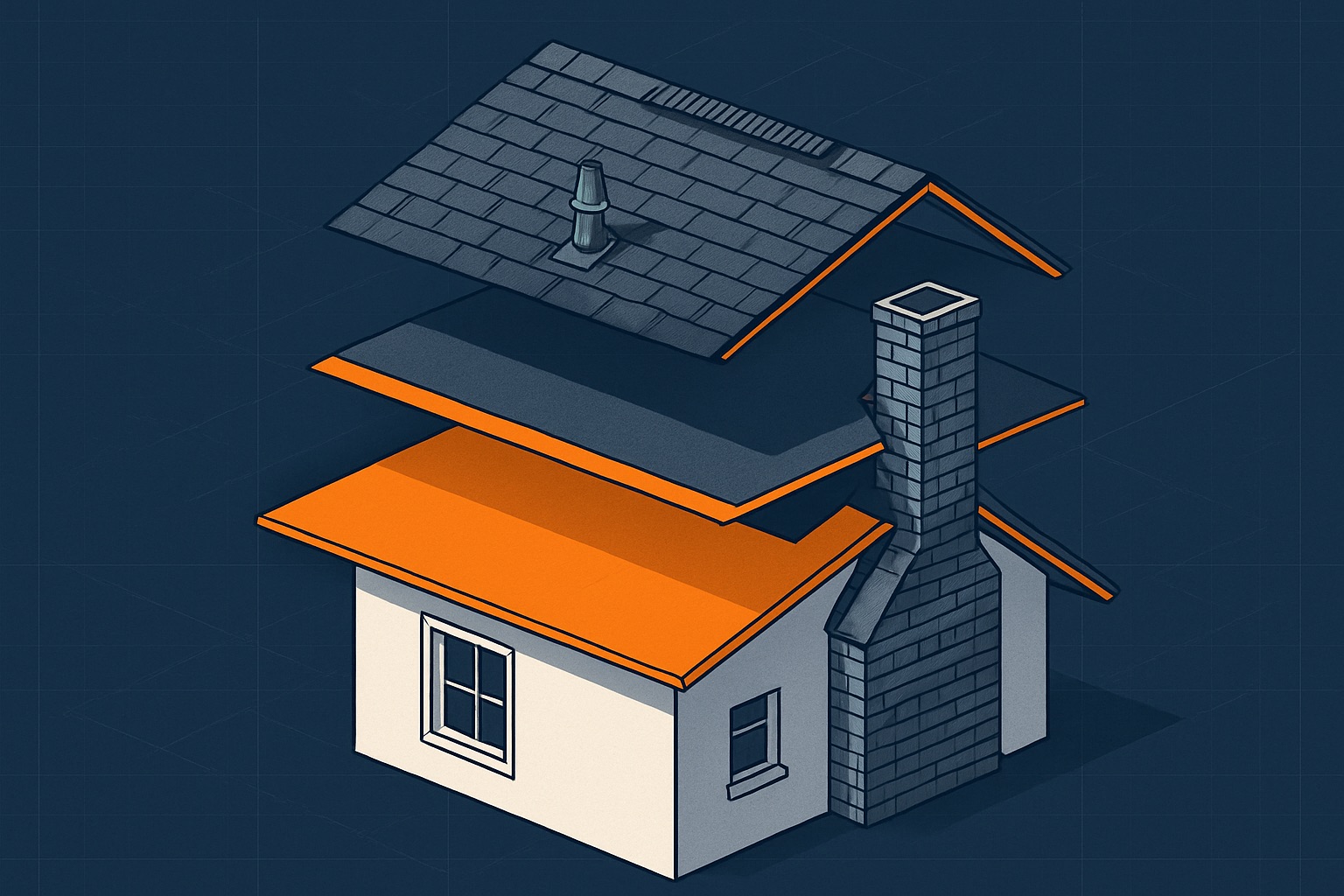
Roof anatomy
- Square
- The unit roofs are measured in: one square = 100 square feet of roof surface. A typical residential roof runs 20–35 squares. Materials, labor, and price all flow from this number.
- Decking (sheathing)
- The wood panels (usually OSB or plywood) fastened to the rafters that everything else is installed on. Rotten decking discovered mid-tear-off is the most common change order.
- Underlayment
- The water-resistant layer (felt or synthetic) between the decking and the shingles — the roof's backup defense when water gets under a shingle.
- Drip edge
- Metal flashing at the roof's edges directing water away from the fascia and into the gutters. Code-required in most jurisdictions — which makes it a common legitimate supplement item.
- Flashing
- Metal installed wherever the roof meets something else — chimneys, walls, valleys, pipes. Failed flashing causes more leaks than failed shingles.
- Pipe boot
- The rubber-and-metal seal around plumbing vents that penetrate the roof. Cracked boots are the leak source reps point out most on inspections.
- Ridge vent
- A vent along the roof's peak letting hot attic air escape — the exhaust half of a balanced ventilation system (soffit vents are the intake half). Ventilation talk is where experts separate from amateurs.
- Gooseneck
- A curved metal exhaust vent on the roof, usually serving a bathroom fan or dryer duct.
- Valley
- The internal channel where two roof planes meet. It carries the most water on the roof — and it's where cut corners show up first.
- Pitch
- The roof's steepness as rise over run — a 6/12 roof rises 6 inches per 12 horizontal inches. Steeper pitch means harder labor, more safety equipment, and a higher price.
- Fascia & soffit
- Fascia is the vertical board at the roof's edge (gutters hang on it); soffit is the underside panel that lets intake air into the attic.
- Ice & water shield
- Self-adhering waterproof membrane at eaves, valleys, and penetrations — code-required along eaves in many northern jurisdictions, and another frequent supplement item.
Products & warranties
- 3-tab shingle
- The older, flat, single-layer asphalt shingle. Cheaper, shorter-lived, and mostly displaced by architectural shingles — but you'll still match them on repairs.
- Architectural (dimensional) shingle
- The modern standard: multi-layer laminated shingles with depth and longer warranties — GAF Timberline HDZ, Owens Corning Duration, CertainTeed Landmark. Know all three lines cold.
- Starter strip
- The engineered first course at the eaves that seals the roof edge — a component of the manufacturer "system" that unlocks upgraded warranties.
- Ridge cap
- Purpose-made shingles for the peak, covering the ridge and ridge vent — another system component.
- System warranty
- Upgraded manufacturer warranty tiers (GAF Golden Pledge, OC Platinum, CertainTeed 5-Star) earned by installing the full branded system through a certified contractor. One of the strongest kitchen-table differentiators a rep has.
- EagleView
- Aerial measurement reports giving exact squares, pitch, and waste factor without climbing the roof — standard in most serious sales operations.
Insurance & storm restoration
- ACV (Actual Cash Value)
- Replacement cost minus depreciation — what the insurer says the roof is worth today. On an ACV-only policy, depreciation is never paid back.
- RCV (Replacement Cost Value)
- The full cost to replace the roof at today's prices. RCV policies pay ACV up front, then release the recoverable depreciation when the work is complete.
- Recoverable depreciation
- The held-back gap between RCV and ACV — the money homeowners most often don't realize they're owed until a rep explains it.
- Deductible
- The homeowner's out-of-pocket share of the claim. Paying it is required — a rep who offers to "eat the deductible" is describing insurance fraud in most states. Walk away from companies that teach it.
- Scope of loss
- The insurer's line-item list of approved damage and costs. When it's incomplete — and it often is — the supplement process exists to fix it.
- Supplement
- A documented request for the insurer to pay legitimate scope the original estimate missed: code items, hidden damage, missed line items. Done right (photos + code citations), supplements routinely add thousands in legitimate scope.
- Adjuster
- The insurer's representative who inspects and writes the scope. The adjuster meeting — walking the roof together, pointing out documented damage — is one of the highest-leverage conversations in storm sales.
- Re-inspection
- A second adjuster visit after a denial or lowball scope, usually with the rep present. A denied claim is not a dead claim — here's the full reopening playbook.
- Contingency agreement
- A signed agreement that the homeowner uses your company if — and only if — the claim is approved. Protects the rep's claim work from quote-shoppers.
- Hail hit / bruise
- The soft, granule-displaced impact mark hail leaves on asphalt — what you circle in chalk and photograph on inspections.
- Wind creasing
- Damage where wind lifted and folded a shingle, breaking its seal — often functional damage even when nothing blew off.
- Storm chaser
- A contractor who follows storms into town, sells hard, and disappears. The stigma every legitimate storm-restoration rep must overcome in the first minute at the door.
Sales-floor language
- Retail vs. storm
- Retail = homeowner pays out of pocket (consultative, price-objection heavy). Storm restoration = insurance-funded after hail/wind (door-knocking heavy, claim-process heavy). Different games, different skills.
- Canvassing / D2D
- Systematically knocking a neighborhood door-to-door — the core prospecting motion of storm-restoration sales.
- Self-gen
- A lead the rep generated personally (knocking, referrals) rather than received from the company. Usually pays a higher commission rate — see the full commission math.
- One-call close
- Signing the deal in the first sit-down instead of leaving a quote to be shopped. The skill that most separates top earners in retail.
- Setter / closer
- A split model: setters knock and book inspections; closers run the appointment and sign. Most reps start as setters.
- Ride-along
- A manager joining appointments to observe and coach. Also the model behind AI "virtual ride-along" recording platforms — see RSA vs Rilla vs Siro.
- Draw
- An advance against future commissions during ramp-up. It's a loan, not a salary — it gets repaid out of your first deals.
- Profit split
- Commission as a percentage (commonly 30–50%) of job profit above a base cost. Rewards selling value; punishes discounting.
- Close rate
- Deals signed ÷ appointments run. Multiplied by doors knocked, it is your income. Every skill you drill raises it permanently.
Knowing the words is step one. Owning them is the job.
Here's the honest difference between a rep who's read this page and a rep who closes: the closer doesn't translate in their head. "Square," "RCV," "ridge vent," "recoverable depreciation" — it's native language, delivered while maintaining eye contact on a porch. That only comes from repetition. It's exactly why Roofing Sales Academy (our product) turns this glossary into vocab games and product-knowledge drills — plus AI roleplay where you use the words in live conversation until they're automatic. We think it's the best roofing sales course there is, and it's $29.99/month with a money-back guarantee.
FAQ
Don't memorize it. Drill it.
RSA turns this glossary into vocab games, product drills, and AI roleplay where you use the words for real — $29.99/mo, money-back guarantee, start in five minutes.
GAF, Timberline HDZ, Golden Pledge, Owens Corning, Duration, CertainTeed, Landmark, EagleView, Rilla, and Siro are trademarks of their respective owners, mentioned for identification only. Definitions are general industry usage; codes, warranty terms, and insurance practices vary by jurisdiction and policy — always verify against local code and the specific policy at hand.